Why A True Satin Stitch Matters
The Satin Stitch has become my go-to stitch lately. Recently I learned that what I thought was a Satin Stitch, was in fact, not. At first I spurned the idea of there being a wrong way to do a Satin Stitch. Then I remembered my early gardening years when you had to learn the rules to know enough to break the rules without breaking your garden.
The same holds true with embroidery stitches. As it turns out, the proper way to execute a Satin Stitch is very important. For one, if you are sharing with a fellow embroiderer how you created your piece, saying Satin Stitch has to mean just that, a Satin Stitch. It's the same with gardening: we can only know we are speaking of the same plant when we use Latin names, not the common slang names of plants.
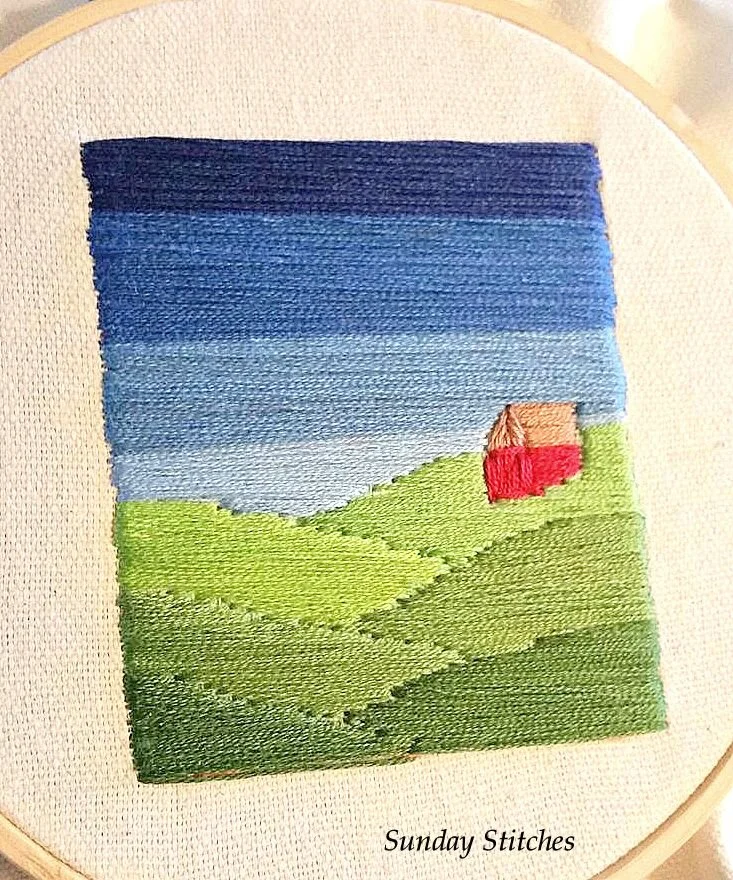
The appearance of a Satin Stitch, that fine, smooth finish as if the threads melted into one piece with delicate undulations can only be achieved with a ton of practice and placing the thread on the fabric the same direction each and every time. The thread has a weave or a texture to it. To achieve a consistent look to each piece of stitched thread each stitch has to be placed in the same direction.
At times I would alter the direction of my stitch I would come up through the fabric at A, and down through B then up again very close to A and then down again very close to B. That is a Satin Stitch. My thread is laying on the fabric the same way with each stitch. But, sometimes I would come up through B and then down near A again. Altering the direction in which my thread was placed over the fabric. That was not a Satin Stitch and those who know embroidery would see that I had not executed a Satin Stitch but what is closer to a Laid Stitch. (More on that later).
This is important to know so you know what you are actually executing. If you are trying to achieve the true look of a Satin Stitch, you have to actually do a Satin Stitch.
Happy Stitching,
Jennifer


Comments
Post a Comment